

Used AWD Cars Under $18,000 That Handle Northeast Snow Commutes
Northeast winters demand more than marketing promises. When you’re merging onto the Hutchinson River Parkway at 6:30 a.m. with 3 inches of fresh snow on the ground, you need AWD that engages before the wheels slip, ground clearance that keeps the undercarriage above rutted slush, and a used-car price that doesn’t require a second mortgage. The sweet spot: AWD sedans and compact crossovers from 2014 to 2018 that deliver 7+ inches of ground clearance, proven torque vectoring systems, and transaction prices under $18,000.
This analysis focuses on three models with documented winter performance in the Northeast corridor: the Subaru Outback (2015-2017), Mazda CX-5 (2016-2018), and Honda CR-V (2015-2017). Each handles snow differently because of weight distribution, AWD logic, and tire-fitment constraints. The goal is not to crown a winner but to match drivetrain behavior to your actual commute pattern, whether that’s stop-and-go urban snow removal zones or unplowed county routes in Westchester or Fairfield County.
Why Ground Clearance Matters More Than AWD Alone
AWD distributes torque to all four wheels, but it does nothing when the chassis drags on a snow ridge at an intersection. The Subaru Outback offers 8.7 inches of ground clearance in all trims from 2015 onward, enough to clear the compacted snow berms that form at Queens Boulevard crosswalks after a plow pass. The Mazda CX-5 offers 8.5 inches on 2016 models, but the redesigned 2017–2018 CX-5 drops to about 7.5 inches. The Honda CR-V sits at about 6.7 inches on 2015–2016 AWD models and rises to 8.2 inches on the redesigned 2017.
For NYC and inner-suburb driving, where plows run frequently but leave 4-inch ridges at curb cuts, about 7.5 inches is the functional minimum, which the 2015-2016 CR-V falls short of. Rural commuters in the Hudson Valley or Connecticut who deal with unplowed driveways and unpredictable town road maintenance should prioritize the Outback’s extra clearance. That difference translates to fewer belly scrapes and less risk of high-centering when you misjudge a snowbank.
One overlooked factor: approach angle. The Outback’s longer wheelbase and wagon profile give it a shallower approach angle than the CX-5 or CR-V, which means it’s more likely to catch a steep driveway apron in deep snow. If your driveway has a sharp incline from the street, the shorter overhangs of the CR-V become an advantage despite slightly less clearance.
Torque Vectoring and How Each AWD System Responds
Subaru’s symmetrical AWD is full-time, sending power to all wheels continuously. The system reacts to slip quickly using an electronically controlled multi-plate transfer clutch on CVT models. In practice, this means the Outback maintains momentum through deep snow without the lag you feel in on-demand systems.
Honda’s Real Time AWD in the CR-V is on-demand and front-biased, sending power to the rear only when the front wheels slip. Under normal conditions, 100% of torque goes to the front wheels to maximize fuel economy (the 2015-2016 CR-V averages 28 mpg combined, versus 25 mpg for the Outback). When the system detects slip, a hydraulic clutch engages the rear axle. The lag is about 0.3 seconds, noticeable when accelerating from a stoplight on a slick surface but negligible once you’re moving.
Mazda’s i-ACTIV AWD (available on 2016+ CX-5 models) is predictive rather than reactive. It monitors outside temperature, wiper activity, and throttle input to pre-engage the rear axle before slip occurs. For Northeast commuters, this means smoother performance in freezing rain and black ice conditions where the road surface changes unpredictably.
The table below compares the three systems on key winter metrics:
| Model | AWD Type | Ground Clearance | Rear Engagement Time | Avg. MPG Combined |
|---|---|---|---|---|
| Subaru Outback 2015-2017 | Full-time symmetrical | 8.7 inches | Always engaged | 28 mpg |
| Mazda CX-5 2016-2018 | Predictive on-demand | 8.5 inches (2016); 7.5 inches (2017-2018) | Before slip occurs | 26 mpg |
| Honda CR-V 2015-2017 | Reactive on-demand | 6.7-8.2 inches | After slip occurs | 28 mpg |
Winter Tire Fitment and Wheel Well Clearance
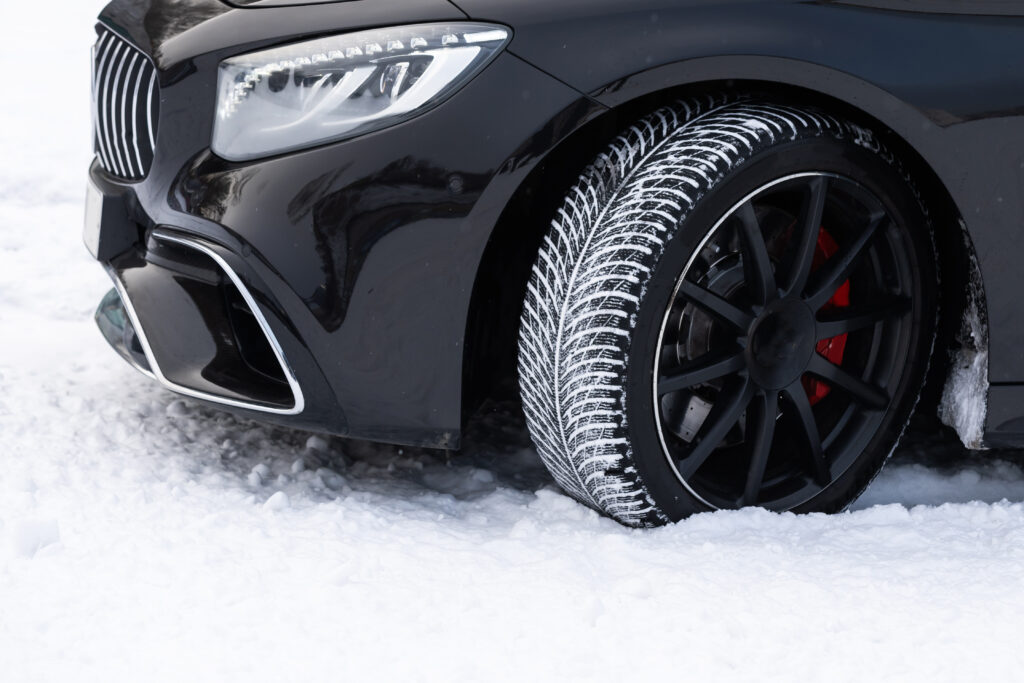
AWD only works if the tires have grip. All three models accommodate 17-inch winter tire packages without rubbing, but wheel well geometry differs. The 2015-2017 Outback accepts 225/65R17 winter tires (the stock size on Premium and Limited trims) with no modifications. Owners report that upsizing to 225/70R17 for additional sidewall height causes minor rubbing at full lock when the wells are packed with snow and ice.
The Mazda CX-5 uses 225/65R17 on Sport and Touring trims (2016-2018), with ample clearance for winter rubber. The Grand Touring trim comes with 19-inch wheels; switching to 225/65R17 winter tires is common and does not affect speedometer accuracy beyond 1.5%. The CX-5’s wheel wells are slightly tighter than the Outback’s, so avoid upsizing beyond stock diameter.
The Honda CR-V (2015-2017) runs 235/65R17 on EX and above trims, with generous wheel well space. Some owners downsize to 225/65R17 winter tires for better snow bite and lower cost, which reduces the contact patch width but improves the tire’s ability to cut through slush to reach pavement. For NYC street parking where you encounter slush, salt, and refrozen melt daily, the narrower 225mm winter tire often outperforms the wider 235mm all-season.
Real-World Northeast Ownership Costs and Rust Exposure
All three models face the same enemy in the Northeast: road salt. Subaru Outbacks from 2015-2017 have documented issues with rear subframe corrosion, particularly on vehicles that spent winters in upstate New York or Massachusetts. Inspect the rear subframe crossmember for surface rust and flaking; if you see rust blisters, walk away. Subaru issued a recall (WTW-20) for 2015-2017 Outbacks to address this, but not all vehicles have been remediated.
The Mazda CX-5 uses a galvanized body that resists rust better than older Mazdas, but the rear wheel wells and rocker panels still accumulate salt. Check the inner fender liners for rust perforation, especially on 2016 models that spent time in the Rust Belt. The CX-5’s undercoating is thinner than the CR-V’s, so budget for annual underbody cleaning if you plan to keep the vehicle past 100,000 miles.
The Honda CR-V has the best rust resistance of the three, thanks to extensive undercoating and galvanized body panels. The main vulnerability is the rear subframe mounting points, which trap salt and moisture. A 2015-2017 CR-V with 80,000 miles will typically show surface rust on the subframe but not structural corrosion. For buyers planning to keep a vehicle past 150,000 miles, the CR-V’s durability justifies a slightly higher purchase price within the $18,000 budget.
Maintenance costs are close across all three, with the Outback’s CVT service as the main difference. All 3.6L six-cylinder (EZ36) engines use a timing chain, meaning they do not require a 105,000-mile replacement. It’s the older 2.5L four-cylinder (EJ25) Outbacks, from 2012 and earlier, that use a timing belt with a $900 to $1,200 service interval, so it isn’t a factor for the 2015–2017 models covered here. The CX-5 and CR-V both use timing chains that rarely need service. Oil changes cost about the same across all three ($45 to $60 for synthetic), but the Outback’s CVT fluid change at 60,000 miles adds $200 to $300.
Which Model Fits Your Northeast Commute Pattern
Choose the Subaru Outback if your commute includes unpredictable road conditions, unplowed rural routes, or deep snow that demands maximum ground clearance. The full-time AWD and higher ride height make it the most capable in deep snow, and the 2.5L matches the CR-V’s 28 mpg combined. Look for 2016-2017 models with the 2.5L four-cylinder and CVT, which balance performance and reliability. Expect to pay $15,000 to $17,500 for a clean example with 70,000-90,000 miles.
The Mazda CX-5 is the best choice for drivers who want predictive AWD and a more engaging driving feel. The i-ACTIV system handles mixed conditions (freezing rain, slush, black ice) better than the CR-V’s reactive setup, and the chassis feels more composed on highway on-ramps. Fuel economy trails the Outback 2.5i by about 2 mpg. Target 2017-2018 Touring models with the 2.5L engine (these sit lower, at about 7.5 inches), typically priced at $16,000 to $18,000 with 60,000-80,000 miles.
Pick the Honda CR-V if your commute is mostly plowed highways and city streets where you need reliability and fuel economy over maximum snow capability. The CR-V’s 28 mpg combined is 3 mpg better than the Outback and 2 mpg better than the CX-5, saving you about $300 annually at current Northeast gas prices. The reactive AWD is adequate for NYC and inner-suburb snow but less confidence-inspiring on unplowed back roads. Look for 2017 models with the turbocharged 1.5L engine, which added more low-end torque for snow starts. Pricing ranges from $16,500 to $18,000 with 50,000-70,000 miles.
Finding the Right AWD Vehicle in Your Budget
The used AWD market under $18,000 is competitive in the Northeast because demand spikes every October. Prices for Outbacks, CX-5s, and CR-Vs rise 8-12% between September and December as buyers prepare for winter. If you’re shopping now, prioritize vehicles with documented service records, winter tire packages already mounted, and no visible rust on the subframe or wheel wells.
When evaluating a specific vehicle, test the AWD system by accelerating moderately on a slick surface (a snowy parking lot or wet grass). The Subaru should feel planted with no hesitation. The Mazda should engage the rear wheels smoothly within a second. The Honda will feel front-biased initially, then stabilize as the rear clutch engages. Any grinding, shuddering, or warning lights indicate a failing AWD coupling, a $1,500 to $2,500 repair.
Major World maintains an inventory of used AWD vehicles across 30+ brands, with transparent pricing and no-pressure sales. Every vehicle undergoes a pre-delivery inspection, and we provide a detailed history report. If you’re ready to find an AWD car that fits your Northeast commute and budget, browse our current stock or visit our Long Island City location to test-drive the models that match your needs.
Share This Post, Choose Your Platform!
Related Posts
Related Post
 The Cheapest Used Cars to Insure in NYC Cost Under $1,200 Yearly
October 20, 2026
 The Specific Things That Break on a City-Driven Used BMW X5
October 8, 2026
 Certified Pre-Owned vs. As-Is: What Actually Changes at Purchase
September 16, 2026
 Best Used Cars for Tall Drivers: 6’2″+ Headroom and Legroom
September 8, 2026


